
IR Twin Lamps
Products - Light Sources
IR Twin Lamps – Efficient and Robust Heating Solutions
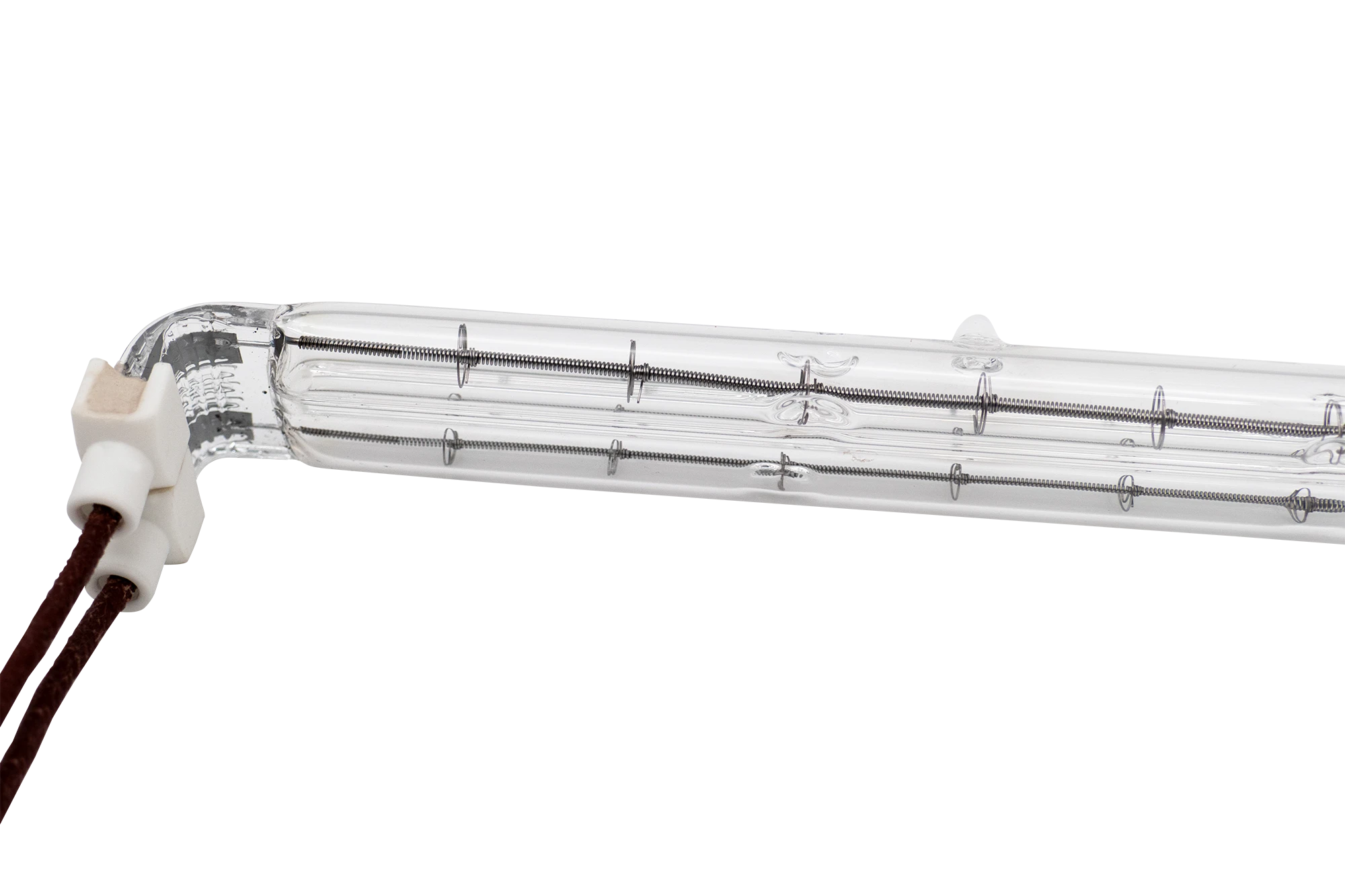
Our twin tube heating elements are engineered for maximum performance in infrared heating applications. Their unique design ensures superior mechanical strength and rigidity, enabling longer element lengths and higher power densities than single tube alternatives. This robust construction also enhances resistance to vibrations and mechanical stress, ensuring reliable operation even under demanding conditions.
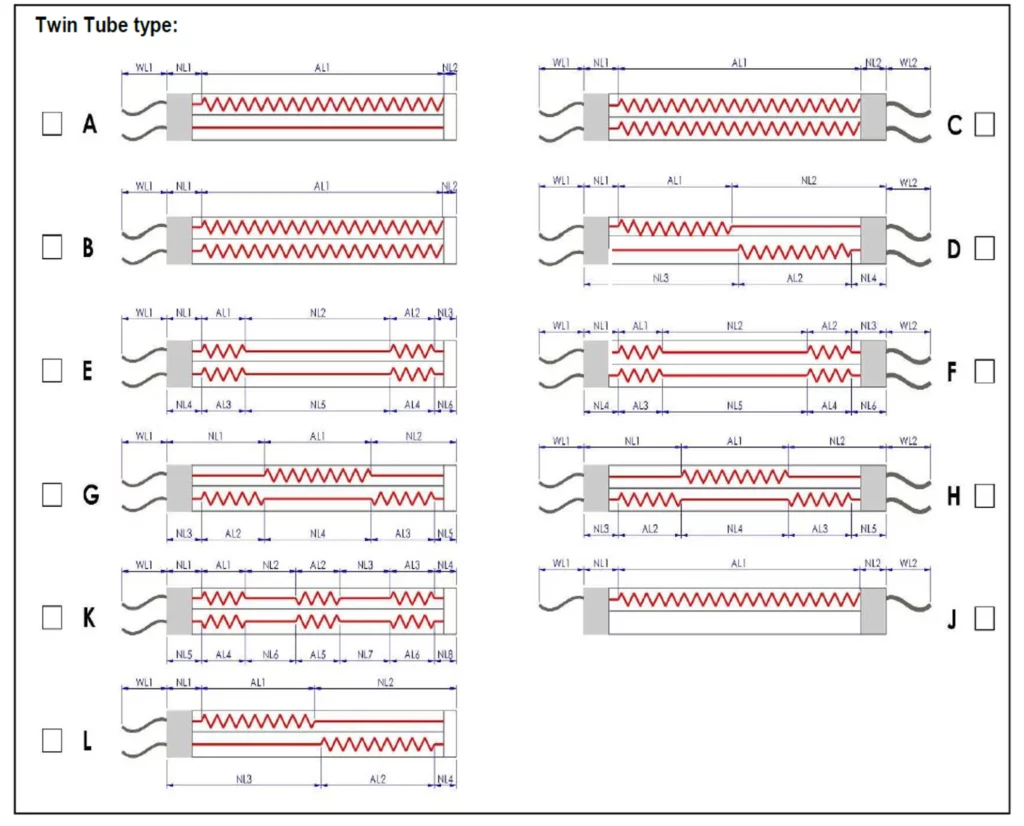
With advanced reflective coatings such as gold or ceramic, our twin tube lamps achieve exceptional energy efficiency by directing heat precisely to the target material and minimizing energy loss. Flexible customization of lead and filament placement further supports seamless system integration and simplifies installation, making IR Twin Lamps a versatile and highly efficient choice for a wide range of industrial applications.
Key Advantages of IR Twin Lamps
- High Mechanical Strength
Twin tube design provides superior rigidity and stability, allowing for longer element lengths and higher power densities. - Improved Energy Efficiency
Reflective coatings such as gold or ceramic maximize heat transfer to the target material while minimizing heat loss. - Enhanced Durability
Robust construction increases resistance to vibrations and mechanical stress, ensuring reliable performance in demanding environments. - Flexible Integration
Customizable lead and filament placement enable easy adaptation to different system designs and simplify installation. - Versatile Heating Options
Available in short wave, fast medium wave, medium wave, and carbon versions to cover a wide range of industrial heating applications. - Recommended for Longer Lengths
Due to their higher chemical stability and mechanical robustness, IR Twin Lamps are particularly recommended for element lengths above one meter, where single tube designs often reach their limits.
IR Twin Lamps by DR. FISCHER Europe
Key Advantages of IR Twin Lamps:
IR Twin Lamps combine high mechanical stability with excellent thermal performance. Their twin tube design allows longer element lengths, higher power densities, and increased resistance to vibrations.
Reflective coatings such as gold or ceramic further enhance energy efficiency, while customizable lead and filament configurations ensure easy integration. With options ranging from short wave to carbon, they provide versatile solutions for various industrial heating applications.
DR. FISCHER Lamp Range
Our IR Twin Lamps are available in different spectral ranges to meet the requirements of various industrial heating processes. Each type offers specific advantages in terms of temperature range, tube design, heating length, and power density. The following table provides an overview of the key specifications for Short Wave, Fast Medium Wave, Medium Wave, and Carbon twin tube heating elements.
IR Twin Lamps – Key Specifications
| Short Wave | Fast Medium Wave | Medium Wave | Carbon | |
|---|---|---|---|---|
| Color temperature of the coil (K) | 2100K – 2900K | 1700K – 2100K | 1100K – 1250K | 1500K |
| Tubes (section in mm) | 1) 33 x 15 2) 23 x 11 |
1) 33 x 15 2) 23 x 11 |
1) 33 x 15 | 1) 33 x 15 |
| Heating length (mm) | 1) 2500 | 5000 | 1) 2500 | 1) 2500 |
| Power density (W/cm) | <200 | 80 | 25 | 60 |
| IR reflectors | ||||||
|---|---|---|---|---|---|---|
| Reflectivity | Durability | Cost | Radiation orientation | Main advantages | Main drawbacks | |
| Gold | ☆☆☆☆☆ | Bad | €€€€€ | Specular |
- Best reflectivity - No thermal inertia |
- Low temperature resistance (<600°C) - High cost |
| White ceramic | ☆☆☆ | Very good | €€ | Diffuse | - Good price-performance ratio | - Reflectivity 10 to 15% lower than gold |
| MLRI | ☆☆☆☆ | Very good | €€€ | Diffuse | - Reflectivity between the white ceramic and gold | - Slightly more expensive and slightly less stable than white ceramic |
| Highly reflective aluminum | ☆☆☆ | Good | €€€ | Specular or diffuse (depends on the finish) | - Can be combined with other reflectors | - Added piece → takes more space |
Typical Applications of IR Twin Lamps:
Drying and Curing
Fast and efficient curing of coatings, adhesives, inks, and varnishes in industrial processes.Plastic Forming and Shaping
Precise and uniform heating of thermoplastic materials for forming, bending, and welding applications.Food Industry Processes
Controlled infrared heating for baking, browning, drying, and sterilization in food production.Textile and Paper Industry
Rapid drying of inks, coatings, and finishes on textiles and paper surfaces.Electronics and Semiconductor Manufacturing
Targeted heating for bonding, soldering, and component processing with high accuracy.Surface Treatment and Coating
Enhanced curing and drying of paints, lacquers, and industrial coatings with minimized heat loss.
By leveraging the efficiency and flexibility of IR Twin Lamp technology, you can achieve faster process times, reduced energy costs, and reliable results across a wide range of industrial heating applications.
Selected Examples from Our Twin Lamp Range
Twin Lamp 1
Example Text. Example Text. Example Text. Example Text. Example Text. Example Text. Example Text. Example Text.
Twin Lamp 2
Example Text. Example Text. Example Text. Example Text. Example Text. Example Text. Example Text. Example Text.
Twin Lamp 3
Example Text. Example Text. Example Text. Example Text. Example Text. Example Text. Example Text. Example Text.